
Complete Guide to Poultry Farming in Nigeria
Introduction
Poultry farming in Nigeria has evolved into one of the most commercially viable agribusiness sectors, driven by the increasing demand for affordable animal protein such as chicken meat and eggs. With a rapidly growing population and urban expansion, consumption continues to rise, creating a consistent and reliable market for poultry farmers across the country.
- Chicken and eggs are among the most consumed protein sources
- Demand is stable throughout the year
- Urbanization is increasing consumption rates
- Strong opportunity for both small and large-scale farmers
However, poultry farming is not simply about raising birds—it is a structured business that requires careful planning, technical knowledge, and disciplined management. Many beginners enter the industry because of its perceived profitability but fail due to poor management, lack of biosecurity, and inadequate financial planning. This guide provides a complete roadmap, connecting every stage of poultry production into a single, practical framework.
- Requires planning and technical knowledge
- Poor management leads to high mortality
- Biosecurity is critical for survival
- Business mindset is essential for success
1. Understanding the Poultry Industry
The poultry industry in Nigeria is a large and interconnected system that includes hatcheries, feed mills, farms, processing plants, and distribution networks. Each segment plays a critical role in ensuring that poultry products reach the final consumer efficiently.
- Industry extends beyond just farming
- Multiple income streams exist
- Integration increases profitability
- Supply chain is highly interconnected
As a new entrant, it is important to decide where you want to position yourself within this value chain. While most beginners start with bird rearing, advanced farmers often expand into feed production or processing to increase margins and reduce dependency on external suppliers.
- Start with rearing, then expand
- Vertical integration improves profit margins
- Feed production reduces costs
- Processing increases value
2. Choosing the Right Production System
The production system you choose determines your operational cost, efficiency, and scalability. In Nigeria, the most common systems are deep litter, cage, and free-range systems, each suited for different levels of investment and management.
- System affects cost and efficiency
- Choice depends on capital
- Each system has advantages and risks
The deep litter system is the most widely used due to its affordability and simplicity. Birds are raised on a floor covered with materials like wood shavings, which absorb waste. While cost-effective, poor management of litter can lead to disease outbreaks.
- Low startup cost
- Suitable for beginners
- Requires strict hygiene management
- Risk of disease if poorly maintained
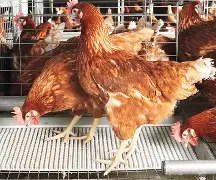
Cage systems are mainly used for layer birds and are designed to maximize egg production efficiency. They allow better monitoring, reduce feed wastage, and improve cleanliness, but require higher initial investment.
- Higher egg production efficiency
- Better monitoring of birds
- Reduced feed wastage
- Higher capital requirement
3. Poultry Housing: Setting Up the Right Environment
Housing is one of the most important investments in poultry farming because it directly affects bird health, growth rate, and productivity. A well-designed poultry house protects birds from extreme weather, predators, and disease while ensuring proper ventilation and temperature control.
- Good housing reduces mortality
- Ventilation prevents disease spread
- Temperature control improves growth
- Design affects productivity
In Nigeria’s tropical climate, heat management is especially important. Overheating can reduce feed intake, slow growth, and increase mortality rates. Farmers must ensure proper airflow and shading to maintain optimal conditions.
- Heat stress reduces productivity
- Ventilation is essential in hot climates
- Shade helps regulate temperature
- Poor housing leads to losses
4. Feeding and Nutrition
Feeding is the single largest cost in poultry farming, often accounting for over 60–70% of total production cost. The quality and composition of feed directly determine growth rate, egg production, and overall profitability.
- Feed is the highest cost component
- Nutrition affects growth and output
- Poor feed leads to losses
- Efficiency determines profit
Birds require balanced diets containing proteins, carbohydrates, vitamins, and minerals. Different growth stages require different feed formulations, such as starter, grower, and finisher feeds for broilers, and layer mash for egg production.
- Different feeds for different stages
- Balanced diet improves performance
- Protein is critical for growth
- Wrong feeding reduces output
5. Disease Control and Biosecurity
Disease outbreaks are one of the biggest threats in poultry farming. A single outbreak can wipe out an entire flock within days, leading to massive financial losses. This is why preventive measures are more important than treatment.
- Diseases spread very quickly
- Prevention is better than cure
- Vaccination is essential
- Biosecurity reduces risk
Biosecurity involves controlling access to the farm, maintaining hygiene, disinfecting equipment, and ensuring that birds are not exposed to contaminants. Successful farms treat biosecurity as a daily routine, not an occasional activity.
- Restrict visitor access
- Disinfect equipment regularly
- Maintain clean environment
- Monitor bird health daily
6. Cost, Profitability, and Scaling
Profitability in poultry farming depends on how well costs are managed and how efficiently birds convert feed into meat or eggs. Farmers who control feed costs, reduce mortality, and maintain high productivity levels achieve the best returns.
- Cost control is critical
- Mortality reduces profit
- Efficiency drives income
- Management determines success
Scaling a poultry business involves increasing bird population, improving infrastructure, and adopting automation. However, expansion should only occur after mastering operations at a smaller scale to avoid large financial risks.
- Scale gradually
- Automate processes
- Reinvest profits
- Reduce risk through experience
7. Investment Breakdown (Small–Medium Scale)
Understanding the financial requirements of poultry farming is critical before starting. Many farmers underestimate costs, particularly feed and mortality-related losses. Below is a realistic cost estimate for a 500-bird broiler operation in Nigeria.
- Costs vary based on location and inflation
- Feed accounts for the largest expense
- Housing is a one-time capital investment
- Operational efficiency affects total cost
| Item | Estimated Cost (₦) |
|---|---|
| Housing Setup | 700,000 – 1,000,000 |
| Day-old Chicks (500) | 400,000 – 550,000 |
| Feed (6–8 weeks) | 900,000 – 1,200,000 |
| Drugs & Vaccines | 150,000 – 250,000 |
| Labor | 100,000 – 200,000 |
| Total | ~ ₦2.3M – ₦3.2M |
8. Revenue and Profit Projection
Revenue in poultry farming depends on market price, mortality rate, and final bird weight. A well-managed broiler farm typically achieves 90–95% survival rate and market weights between 2.0–2.5kg per bird.
- Higher survival rate increases revenue
- Market timing affects selling price
- Bird weight determines final income
- Direct sales improve margins
| Metric | Value |
|---|---|
| Birds Sold | 450 (after mortality) |
| Average Price per Bird | ₦6,500 |
| Total Revenue | ₦2,925,000 |
| Total Cost | ₦2,500,000 (avg) |
| Estimated Profit | ₦400,000 – ₦700,000 per cycle |
With proper management, a farmer can run 5–6 cycles per year, depending on downtime and operational efficiency. This creates a strong annual income potential when operations are stable.
- Multiple cycles increase yearly income
- Consistency is key to profitability
- Reinvestment accelerates growth
- Efficiency compounds returns
9. Return on Investment (ROI)
ROI in poultry farming is relatively fast compared to many other agricultural ventures. Since broilers mature within 6–8 weeks, investors can recover capital quickly and reinvest within the same year.
- Short production cycle enables fast returns
- ROI depends on efficiency and cost control
- Reinvestment accelerates business growth
- Cash flow is frequent and predictable
A well-run farm can achieve 15–25% return per cycle. However, this depends heavily on management quality, feed pricing, and disease control.
- High returns possible with good management
- Poor management leads to losses
- Feed cost volatility affects ROI
- Risk must be actively managed
10. Risk Analysis (Realistic View)
Every serious investor must understand that poultry farming is not risk-free. The biggest difference between profitable farms and failed ones is how risks are managed, not avoided.
- Risk is unavoidable but manageable
- Preparation reduces impact
- Experience improves decision-making
- Systems reduce human error
The major risks include disease outbreaks, feed price fluctuations, poor management, and market instability. These risks can significantly affect profitability if not properly controlled.
- Disease can wipe out entire flock
- Feed price increases reduce profit
- Poor management leads to high mortality
- Market timing affects selling price
11. Scaling Strategy (From 500 to 5,000 Birds)
Scaling a poultry business should be done strategically, not emotionally. Expanding too quickly without proper systems often leads to large-scale losses instead of increased profit.
- Scale based on experience, not excitement
- Build systems before expansion
- Reinvest profits gradually
- Automation improves scalability
A typical growth path involves starting with 500 birds, mastering operations, then scaling to 1,000–2,000 birds before moving into larger commercial operations.
- Step-by-step growth reduces risk
- Learning improves efficiency
- Systems improve consistency
- Scaling increases total revenue
12. Advanced Profit Strategies
Experienced poultry farmers increase profitability not just by raising birds, but by controlling more parts of the value chain. This includes feed production, hatchery operations, and direct distribution.
- Feed production reduces cost
- Direct sales increase margins
- Processing adds value
- Branding increases pricing power
Farmers who integrate these strategies often outperform those who rely solely on bird sales. This is what separates small farmers from agribusiness operators.
- Integration increases income streams
- Reduces dependency on suppliers
- Improves long-term sustainability
- Builds a scalable agribusiness
Conclusion
Poultry farming in Nigeria remains one of the most practical and profitable agribusiness opportunities available today. With proper planning, disciplined management, and a focus on efficiency, farmers can build sustainable and scalable poultry businesses.
- Strong demand ensures steady income
- Management determines success
- Efficiency improves profitability
- Scaling creates long-term growth
