How to Grow Cashew in Nigeria: A Practical Guide to Cashew Farming, Cost, Yield and Profit
Cashew farming is becoming one of Nigeria’s most commercially important tree-crop opportunities. Beyond the familiar cashew nut, the crop supports a wider value chain involving farmers, aggregators, processors, exporters, food manufacturers and other businesses.
Nigeria has a long-established cashew industry, with production spread across many states. The Nigerian Export Promotion Council (NEPC) identifies about 19 major producing states and describes Nigeria as a major global source of raw cashew nuts. More recent industry data places annual production in the range of roughly 300,000–350,000 tonnes, while the Federal Government is now pursuing a roadmap aimed at increasing local processing and investment.
For a farmer, however, the most important question is simple: how do you establish a cashew farm that can remain productive and profitable for many years?
Choosing Land and Establishing a Cashew Farm
Cashew performs well in Nigeria’s warm tropical and sub-tropical environments, particularly across the North-Central, South-West and parts of the South-East and South-South. States associated with significant production include Kogi, Kwara, Oyo, Ogbomosho areas of Oyo State, Osun, Ekiti, Ogun, Nasarawa, Niger, Benue, Enugu, Anambra and others.
Good drainage is important. Cashew does not perform well where water remains around the roots for long periods. Sandy-loam and well-drained soils are generally suitable, while extremely waterlogged land should be avoided.
One of the most important decisions is the planting material. Improved or grafted seedlings can offer better uniformity and earlier production than poorly selected planting materials. Farmers should obtain seedlings from reputable nurseries and pay attention to variety, health and suitability to their location.
Cashew is a long-term investment. Unlike maize, rice or beans, it does not provide a full commercial harvest within one season. The advantage is that, once properly established, a cashew orchard can continue producing for many years.
Spacing depends on the production system and variety, but a common commercial approach is around 8 m × 8 m or 10 m × 10 m, giving approximately 100–156 trees per hectare. Farmers should consider the variety, soil fertility, canopy development, mechanisation and whether they intend to use a closer-spacing system before deciding on the final layout.
The young trees require serious attention during establishment. Weed competition can slow growth, while termites, pests, fire and grazing animals can damage young plants. Regular weeding, protection and appropriate fertilisation during the early years can determine how quickly the orchard becomes productive.
Flowering, Pollination, Harvesting and Yield
Cashew requires patience. The exact time to first commercial production depends on the planting material and management system, but improved planting materials can bring production earlier than traditional seed-grown trees.
During flowering and fruit development, farmers need to monitor pests and diseases, maintain orchard hygiene and avoid unnecessary stress on the trees. Good sunlight penetration and proper canopy management become increasingly important as the orchard matures.
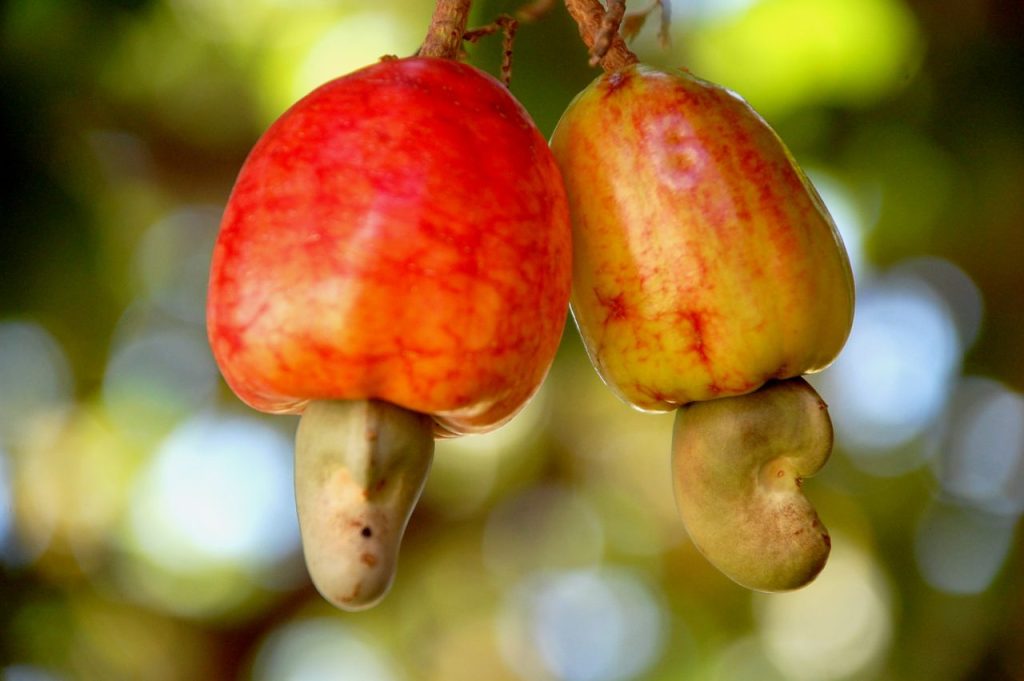
Cashew harvesting is different from harvesting many annual crops because the farmer is collecting both the cashew apple and the nut attached to it. In commercial production, the nut is usually the primary product.
When the cashew apple becomes mature and naturally falls from the tree, the nuts can be collected. Farmers should avoid leaving harvested nuts exposed to excessive moisture or contamination. After collection, the nuts need to be properly separated, cleaned and dried.
Moisture management is particularly important for farmers selling into commercial and export markets. Nigeria’s current export procedures specify a maximum moisture level of 9% for raw cashew nuts, while kernel outturn ratio (KOR) is an important measure of quality.
Yield varies substantially according to variety, age of trees, planting density, soil, rainfall and management. Older NEPC industry data gives a broad range of about 300–800 kg of raw nuts per hectare, while more recent sector data indicates that average productivity remains relatively low compared with the potential of improved orchards.
This productivity gap is important: increasing yields through improved seedlings, better orchard management and replacement of ageing trees can potentially increase farmer income without necessarily requiring a proportional increase in land area.
How Much Does It Cost to Start Cashew Farming?
Cashew farming has a different cost structure from annual crops because a significant portion of the investment occurs before the farm reaches full production.
Major expenses can include:
- Land acquisition or preparation
- Improved seedlings
- Clearing and field preparation
- Pegging and planting
- Labour
- Fertiliser and soil amendments
- Weed control
- Pest and disease management
- Farm maintenance
- Harvesting and collection
- Drying and storage
- Transportation
The cost per hectare can vary dramatically depending on whether the farmer already owns the land, the price of seedlings, labour rates, location and how intensively the orchard is managed.
For that reason, farmers should not rely on a single national figure for “the cost of cashew farming.” A farmer in Kogi, for example, may face a very different land, labour, seedling and transportation cost structure from a farmer establishing an orchard in Oyo or Nasarawa.
The economics should instead be calculated around cost per hectare, expected tree population, expected yield, farm-gate price and the number of productive years.
For illustration only, assume a mature farm produces 600 kg of raw cashew nuts per hectare and the farmer sells at an average farm-gate price of ₦1,000 per kg. Gross revenue would be:
600 kg × ₦1,000 = ₦600,000 per hectare
If the farm produces 1,000 kg at the same price:
1,000 kg × ₦1,000 = ₦1,000,000 per hectare
These figures are illustrations, not current guaranteed market prices. Actual profitability depends heavily on the selling season, nut quality, location, buyer demand, logistics and prevailing market prices.
This is precisely why farmers and traders need reliable commodity-market information. A farmer who understands regional prices and buyer demand may have more options than one who sells immediately at the nearest farm gate.
The Biggest Opportunity May Be Beyond Raw Cashew
Nigeria’s cashew industry has historically been heavily focused on exporting raw cashew nuts. NEPC reports that more than 85% of Nigerian cashew production has traditionally been exported in-shell.
That creates an important opportunity for local value addition.
Cashew can generate economic activity through:
Raw nuts → cleaning → grading → processing → kernels → packaging → retail/export
There are also opportunities around cashew apples. The apple can be processed into juice, beverages, alcohol-based products, animal feed ingredients and other products where commercially viable processing systems are available.
The Federal Government’s 2026 Cashew Industry Roadmap specifically identifies local processing, investment, employment and export growth as priorities. The government noted that Nigeria produces roughly 300,000–350,000 tonnes of raw cashew annually while more than 85% is exported without processing.
That means the opportunity is not limited to owning a farm.
There is potential for businesses involved in aggregation, warehousing, quality testing, processing, packaging, logistics, export financing, equipment supply and market intelligence.
In 2025, NEPC reported that cashew nuts generated US$456.9 million in Nigerian non-oil export receipts. NBS-based reporting also recorded strong growth in exports of cashew nuts in shell during 2025.
For agricultural investors, that makes cashew particularly interesting as a crop that connects smallholder agriculture with international commodity markets.
Common Challenges in Cashew Farming
Cashew farming is profitable only when the major risks are properly managed.
One major challenge is old and low-yielding plantations. The Nigerian cashew industry has been working toward replacing ageing trees with improved varieties.
Another challenge is poor post-harvest handling. Nuts with excessive moisture, contamination, poor drying or physical defects can attract lower prices.
Farmers can also face price volatility. Cashew is an internationally traded commodity, meaning local prices can be influenced by international demand, exchange rates, processor requirements, harvest volumes and export activity.
Access to finance is another constraint because the farmer must spend money establishing and maintaining an orchard before receiving significant returns.
Land security is also important. Because cashew is a long-term crop, farmers should have secure rights to the land before investing heavily in orchard development.
Is Cashew Farming Profitable in Nigeria?
Cashew farming can be profitable, but it should be viewed as a long-term agricultural investment rather than a quick-income crop.
The strongest economics can come from combining good planting material, high orchard productivity, quality management and intelligent marketing.
A farmer who plants thousands of trees but neglects the orchard may obtain disappointing yields. Similarly, a farmer who produces good-quality nuts but sells without understanding market conditions may leave value on the table.
The business becomes even more interesting when farmers participate in organised aggregation or cooperatives, because larger volumes can improve access to processors and potentially reduce individual marketing and logistics challenges.
For investors, another question is whether the opportunity lies in establishing farms, acquiring mature orchards, financing aggregation, building processing capacity or creating technology that connects producers to buyers.
Frequently Asked Questions About Cashew Farming in Nigeria
How long does cashew take to produce?
Cashew is a long-term tree crop. Improved planting materials can begin producing earlier than traditional trees, but farmers should plan financially for a period of establishment before expecting significant commercial harvests.
Which states are suitable for cashew farming in Nigeria?
Cashew is cultivated across a broad belt of Nigeria, including Kogi, Kwara, Oyo, Osun, Ekiti, Ogun, Nasarawa, Niger, Benue, Enugu, Anambra and other states.
How much can one hectare of cashew produce?
Yield varies considerably. Older NEPC data gives approximately 300–800 kg/ha, while sector programmes indicate that productivity can improve significantly with better planting materials and farm management.
Is cashew mainly for export?
Nigeria has historically exported a large proportion of its raw cashew production, but local processing and domestic consumption are growing areas of interest.
Can cashew farmers make money from the cashew apple?
Yes. The cashew apple has potential for juice, beverages and other processed products, although commercially viable utilisation requires appropriate processing, storage and market access.
What makes cashew nuts valuable to buyers?
Quality factors include moisture content, nut count, kernel outturn ratio, defects and general physical condition. Export-oriented buyers may also have specific quality and food-safety requirements.
Commodity.ng Insight
Cashew is more than a tree crop. It is an entire commodity ecosystem.
Nigeria already has the production base, international demand and growing investor interest. The bigger opportunity is to move more of the value chain from farm to factory.
For farmers, this means better seedlings, better orchard management, better harvesting and better market information. For entrepreneurs, it means opportunities in aggregation, processing, packaging, logistics, finance and export. For investors, it means looking beyond the farm gate and understanding where value is created throughout the supply chain.
At Commodity.ng, we believe agricultural profitability starts with better information.
Knowing the current price of cashew is useful. Knowing where prices are strongest, where supply is increasing, where processors are buying, how harvest timing affects prices, how quality affects value and where investment opportunities are emerging is even more powerful.
The future of Nigerian cashew will not depend only on producing more nuts. It will depend on producing better-quality nuts, processing more locally and connecting Nigerian producers to markets with better data.
Commodity.ng — turning agricultural data into market intelligence.
Discover more from Commodity Nigeria
Subscribe to get the latest posts sent to your email.