
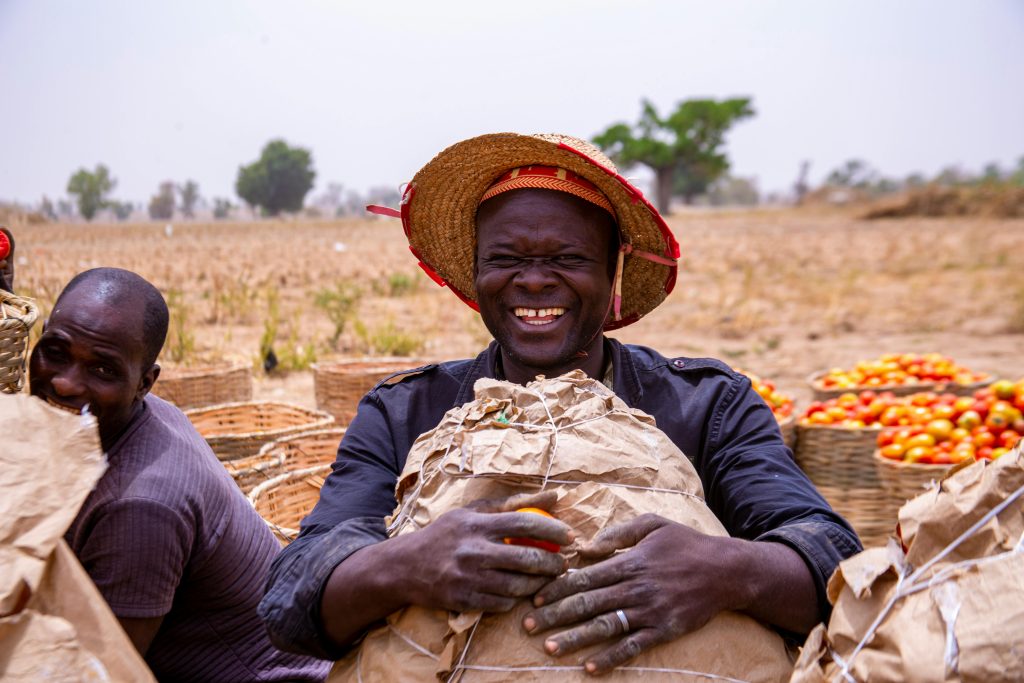
Nigeria’s agricultural sector continues to face deep structural challenges that prevent farmers from fully benefiting from their hard work. According to leaders within the All Farmers Association of Nigeria (AFAN), the growing dominance of middlemen, poor market coordination, weak policies, and limited access to infrastructure are contributing significantly to rising food prices and worsening conditions for farmers across the country.
Speaking on the situation, AFAN’s National First Deputy President, John Olateru, explained that many farmers remain trapped in a cycle where they produce food but have little control over how their goods are priced, stored, or sold. He noted that because many farmers lack proper storage facilities, processing centers, and direct market access, they are often forced to sell their produce immediately after harvest at extremely low prices.
According to him, middlemen take advantage of this situation by buying farm produce cheaply during harvest season, storing the goods, and later releasing them into the market at much higher prices. As a result, consumers pay more for food while farmers still remain poor.
He stressed that the current system heavily favors traders and commodity merchants over actual producers, leaving farmers with minimal bargaining power.
The AFAN leader also pointed out that financial institutions often prefer to fund merchants and aggregators rather than farmers themselves. Many banks see farming as risky due to climate uncertainty, poor insurance systems, and unstable market conditions. This has made it difficult for farmers to access affordable financing needed to expand production or improve operations.
Beyond market challenges, he highlighted the impact of climate-related problems such as irregular rainfall patterns, flooding, and crop losses. In many cases, farmers who experience losses are unable to receive insurance compensation, further discouraging investment in agriculture.
He also raised concerns over the effectiveness of government agricultural intervention programmes, stating that many support funds meant for farmers fail to reach the actual beneficiaries at the grassroots level.
Commodity.ng Insights: Why Agricultural Data Matters More Than Ever
The challenges highlighted by AFAN reveal a deeper issue within Nigeria’s agricultural ecosystem — the absence of reliable, transparent, and accessible market data for farmers.
One of the biggest problems facing Nigerian farmers today is information imbalance. Farmers often do not know the real market value of their produce, current demand levels, buyer trends, storage opportunities, or the best locations to sell. This gap creates an environment where middlemen dominate pricing and distribution.
Commodity.ng believes that agriculture can only become truly profitable when farmers have access to accurate market intelligence and real-time agricultural data.
Across developed agricultural economies, farmers use data to guide planting decisions, pricing strategies, market timing, logistics planning, and storage management. In Nigeria, however, many smallholder farmers still operate blindly without access to structured agricultural intelligence.
Data-driven agriculture can help solve several of the problems affecting farmers today, including:
- Improving price transparency across markets
- Helping farmers identify better buyers
- Reducing exploitation by middlemen
- Supporting aggregation and cooperative selling
- Forecasting demand and reducing oversupply
- Improving access to financing through verified production records
- Strengthening food supply chain coordination
- Reducing post-harvest losses through better logistics planning
Commodity.ng sees agricultural data not just as information, but as economic power for farmers.
Building a More Structured Agricultural Economy
Nigeria’s food inflation problem is not only about low production. In many cases, food is available, but the system connecting farmers to markets remains inefficient, fragmented, and poorly coordinated.
Experts increasingly believe that solving Nigeria’s food crisis will require more than increasing farming activities. It will require building stronger agricultural systems around storage, processing, transportation, pricing intelligence, financing, and digital market access.
Commodity.ng’s ongoing focus on agricultural insights, market trends, commodity tracking, agribusiness education, and value chain intelligence reflects the growing need for a more data-driven agricultural economy in Nigeria.
As conversations around food security continue nationwide, stakeholders are beginning to recognize that empowering farmers with information may be just as important as empowering them with seeds, fertilizers, or machinery.
In a rapidly changing agricultural landscape shaped by climate change, inflation, insecurity, and volatile markets, access to reliable agricultural data may become one of the most important tools Nigerian farmers need to survive and thrive.
Discover more from Commodity Nigeria
Subscribe to get the latest posts sent to your email.



All the best
Enjoy every single day
yahoo,im go
Wish you happiness
Every day is a new beginning
Hahahaha You are so good
Ahaa, its nice dialogue regarding this article at this place at this
blog, I have read all that, so now me also commenting here.
Great post,Thanks for sharing